Warning: this is a rant!
South Africa has been in the throes of a public service strike. I understand that civil servants, who make a country run, need to earn a living wage. I don't understand why teachers at private schools, who earn a decent salary, need to strike. Nor do I understand how striking workers could deny an injured man access to Chris Hani Baragwanath Hospital after he was the victim of a hit-and-run accident.
This really happened. Yesterday, my housecleaner's son was run over by a car, which didn't stop (great karma to that driver...) A concerned bystander dragged the inert man into a minibus taxi and took him to hospital, where he was told they couldn't go inside for treatment. This is a poor man, not one who has private health insurance, and certainly not one who has enough money to pay the deposit at a private hospital. He may die. The striking healthcare workers made sure of that. To me, it is not OK to deny the sick and injured access to treatment while you are on strike, because the death and suffering that results accrues to your karma.
Today, please send a prayer or thought to this man, as his mother tries to arrange treatment for him.
PS: If you are wondering why I am still a bit erratic on the blogging front, it's because I am disinclined to be online right now, as it seems to make me anxious, but I am thinking of you all in between teaching teaching teaching!
Showing posts with label life views. Show all posts
Showing posts with label life views. Show all posts
Thursday, June 14, 2007


Tuesday, January 23, 2007
Get OFF the mat!
Yesterday a student came to chat to me after class. He stood on my yoga mat. I tried really hard not to, but in the end I had to ask him to get off. Uptight behaviour? Probably. It's just that my mat seems like an extension of me, and standing on it without permission is a lot like standing on my toe without permission. The poor man was somewhat taken aback, as I usually seem quite relaxed.
I never stand on people's mats unless I am giving an adjustment, or the class is so crowded it is impossible not to. I wouldn't want to step on their toes. For the rest of the day, I noticed the mat behaviour of other people. Interestingly, nobody else stood on my mat. They stepped around it, or stood on the floor next to it if they wanted to chat. Now I don't deliberately tell people I have a 'mat thing', so how did they get there?
I think it may be an issue of boundaries and personal space - different for all of us, and issues always arise when one personal has different ideas of personal space to another.
I would love to know what you all think!
Wednesday, January 10, 2007
Goodies
I love goodies that make life more interesting. One of my current favourites is Soil's Rose Geranium Organic Hydrosol, which I get from Greenlands. Its basically a yummy flower water - I spray it on the bedlinen when making the bed, on my face and neck when I am overheated, and sometimes just into the air to scent the room. And the best thing: it only costs R30 or thereabouts. It's great for the conscience because it is locally and organically produced, too.
Another fave is my Bloom lipgloss, from Woolies new cosmetics counter - a very welcome gift from a friend.
It's these little things that make each day special for me.
What are yours?
Another fave is my Bloom lipgloss, from Woolies new cosmetics counter - a very welcome gift from a friend.
It's these little things that make each day special for me.
What are yours?
Thursday, January 04, 2007
Balance
It’s so ironic: I am a yoga teacher (which, lets be honest, implies a more relaxed lifestyle than usual) and I found myself with a chronic shortage of time and energy towards the end of last year. Maybe I felt left out when I heard everyone else’s complaints about working too hard/not having enough time?
These days, it really is difficult to live a balanced life, since more and more seems to be expected of us, and there are still only 24 hours in a day. Yoga means union and therefore balance between ha (sun) and tha (moon). This balance needs to apply to all polar opposites – our masculine and feminine selves, upper and lower body, heaven and earth, back and front, left and right, work and play. But how do we even think about getting there?
It depends a lot on how balanced you feel – we all have a different comfort zone for how hard we can work (or play) without getting ill, or depressed, or just plain grumpy. As a rule, all of us need at least a little quiet time every day to recharge the batteries. Look at your life, and try to earmark what needs to be changed.
Go through all the main areas: work, family, studies, social, spirituality and so on. Note which areas are fine, and which are a drain. Some things can’t be changed, and some can, but there is usually a way to make your days flow more smoothly. If you are a parent, and your kids are small, the concepts of free time and sleep will be foreign to you, but it is ok to cut down in other areas like socialising. Also decide what is important to you and what isn’t; notice how much time you actually spend on the unimportant stuff (it’s almost certainly not all necessary) and see whether that can be reduced.
For example, although I absolutely love my work, one of my main issues was the amount of driving I was doing – it wasn’t unusual for me to spend four hours a day in the car. Now I don’t like driving. I give the keys to my husband every time we go anywhere together. Clearly I had to change something. It wasn’t easy, because it meant I had to give up classes with people I had grown fond of, but the situation couldn’t stay as it was, so I did what I had to do. Granted I was prompted by illness, but you could be more sensible and do something before you get sick!
If you find that your actual job is causing most of the stress – perhaps the environment is very high pressure and you really hate being there – that too can change. There is always a way, if you allow yourself a little time and space to consider the options. If you really give yourself permission to change jobs or careers, opportunities seem to appear out of nowhere.
It may just be a matter of changing how you do things – instead of driving from one end of the city to the other, try to arrange your activities so they are all in the same area on a given day. Sometimes less is more too – you don’t have to accept every invitation that comes your way. If you prefer to spend that time in a nice bubble bath, do it!
Any yoga practice helps us feel where and how we are out of balance, by bringing our awareness to the quality of our breath (which is invariably short and restricted when we are stressed) and also to the sensations in front and back, left and right. A practice that emphasises asymmetrical poses, or forward bends paired with backbends, will help this process along.
And of course, actual balancing poses are very useful! Ironically, if you try to do one-legged balancing poses with an unfocused mind, you will wobble, but they also clear the mind, so if you persist through the wobbling, you feel more balanced afterwards.
My favourite is tree pose (vrksasana).
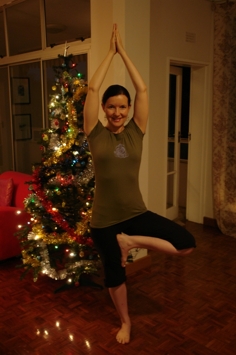 Stand with feet together, toes spread wide, and equal weight through both feet. Slowly shift the weight to your right foot, and place your left foot against your right inner thigh (or knee, or ankle, doesn’t matter). Keep the weight through the midline of your body, and if you are feeling balanced, as you inhale, raise your arms out to the sides and up, to touch palms overhead, then exhale to draw your hands to your heart in anjali mudra. (below)
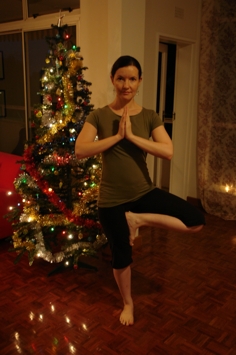 Either stay for six breath without the arm movement, or repeat the arm movement six times with the breath. Then change sides. Ahhhhh, balance. (Yes, the tree in the background was deliberate!)
Notice which side felt easier, and how the left side felt different to the right. If you want to warm up before practicing tree, do dynamic tadasana six times first. Stand with feet together, inhale to come up onto tiptoes and raise arms out to and up, exhale to come down. Arms and feet move in unison with breath.
You can also try a simple pranayama breathing exercise, called anuloma (with the grain) ujjayi. Sit comfortably, either on the floor or a chair, and start to breath in and out using ujjayi breath, constricting the back of the throat so it sounds a bit like you are snoring. When you are comfortable, start to breathe out through alternate nostrils, using your right hand to control the flow of air. So breath in: ujjayi, breath out: left nostril (release the sound in the throat), breathe in at the throat, breath out: right nostril, and so on. Notice the difference between sides. Do a few rounds of this then rest, breathing normally, and notice how your breath feels.
As always, please make sure you are in good health before trying these exercises and stop if you feel anything is amiss.
Wednesday, January 03, 2007
Can but Shouldn't
 I spent several years learning arm balances, mostly, if I am honest, to impress other people. They make my wrists hurt. They make me grumpy. Have a look at this photo of me doing bakasana (crane or crow pose) a couple of months ago; you can see the frown even in this teensy little pic.
So why do them if I hate them? Well, actually I don't anymore. When I had my yoga consultation at KYM, my teacher asked me not to do arm balances. At least not every day (they are very clever, they never outright ban things, knowing of course the appeal of the forbidden.) Apparently, women (especially those over 30, sigh) are not ideally designed to take so much weight in the arms, and our joints degrade over time, no matter how strong and flexible the musculature is.
The other day, I was chatting to my friend Ann, who is also a yoga teacher and one I really admire. She mentioned that she thought if I came back to a regular power or vinyasa yoga practice, I would hate it, because my practice is so focused on the breath now. Bah! I thought to myself. How would she know? So I tried a podcast vinyasa class at home. There were arm balances. I kept being instructed to move when I was halfway through a breath. It made me grumpy. It made my wrists hurt. In fact, just to make myself feel better, I ended up doing my regular practice, so I could feel my breath moving me.
I was able to do all the poses, but the question is: should I have? More and more, I believe yoga is a tool, not an end in itself, and the postures serve the breath, not the other way around. A competitive, goal-driven practice often distracts us from our inner worlds, and can sometimes lead to physical injury or emotional upset. Just as with all things in life, you need to do it the right way for you - there is nothing wrong with a rigourous practice, as long as it is making you feel better (honestly) and serving to lengthen and smooth the breath (again - being honestly aware of your breath). Its the honesty that's the bummer - my ego loves doing the flashy poses, but really, for me right now, they are not necessary. And I feel much better than I did before, both physically and emotionally.
Sunday, December 24, 2006
I love yoga!
I have had a bit more time the last few days, so I have done some really long yoga practices. It's like a giant splash of water in the desert. When I am busy and physically exhausted, sometimes it feels like a chore to come to the mat, but right now, I am being reminded of just why yoga has held my interest for so long, and why I feel compelled to share its joys with as many people as possible.
For the last two days, I have dedicated my practice to releasing anger and family healing, and I find myself looking forward to the coming festivities with an open heart. It's funny how talking about our issues tends not to make us feel much better about the situation, while actively doing something (like dedicating your yoga practice to a solution) does. Same with meditating - endless self-analysis falls far short of just sitting and listening to the small quiet voice within.
Although I am still working with that hamstring injury, there are so many ways to experience a full practice and I am grateful for the learning that always comes with injury. I have found a new 'sun salute' sequence that doesn't involve the deep lunging or forward bends that are currently out of the question, and I come off the mat feeling refreshed and open.
Hope you all enoy the benefits of your practice, Happy Christmas!
For the last two days, I have dedicated my practice to releasing anger and family healing, and I find myself looking forward to the coming festivities with an open heart. It's funny how talking about our issues tends not to make us feel much better about the situation, while actively doing something (like dedicating your yoga practice to a solution) does. Same with meditating - endless self-analysis falls far short of just sitting and listening to the small quiet voice within.
Although I am still working with that hamstring injury, there are so many ways to experience a full practice and I am grateful for the learning that always comes with injury. I have found a new 'sun salute' sequence that doesn't involve the deep lunging or forward bends that are currently out of the question, and I come off the mat feeling refreshed and open.
Hope you all enoy the benefits of your practice, Happy Christmas!
Monday, December 18, 2006
A little bit of festive giving
I spent a very miserable two hours at the mall yesterday. It couldn't be helped. I had to finish my Christmas shopping. This happens every year - I get excited about the fun family activites and then remember that mostly, this holiday is all about stuff.
Even if you are a practising Christian, celebrating the birth of Christ is secondary to trying to show people you love them with extravagant gifts you probably can't afford. I am afraid the whole phenomenon brings out the Scrooge in me. Last year I even tried to forbid people to give me Xmas or birthday presents (my birthday is five days after....) I failed. There was too much rich food, which caused stomach upsets and the occasional inference from extended family that perhaps I visit the toilet a little too often. There was maudlin drunkenness (not on my part, but hey, I visit the loo too often.) There were kids high on sugar and toys, throwing tantrums. All in all a regular Christmas.
My thoughts always turn to what this celebration should be, rather than what it is, and I scrabble desperately to hold on to that spirit. Christmas, although ostensibly celebrating only the birth of Jesus, also incorporates other, older festivals like Yule and Saturnalia. Many of the traditions we observe have their origin in these earlier celebrations. Both were observed at or around midwinter, celebrating the turn of the seasons once again toward spring, and new life. I think that midwinter celebrations, although they tended to be more macabre than those of spring or summer, were a way for ancient communities to pull together and survive the colder, harder months, the ones where food may have run short. It is also interesting that most of these celebrations involved light or fires too - once again symbolically staving off the hardships at the dead of winter.
Of course, in the southern hemisphere, many of these traditions make no sense - it is the hottest, most fertile time of year for us, and the food, fires and mulled wine are completely out of place. Be that as it may, we all face similar challenges around fuss-free family togetherness. This year, both my husband's family and my own have agreed to give token gifts, so we can enjoy giving and receiving without the accompanying stress. I'll let you know how that worked out. So far better than any year before. We are also making many of our gifts - foodie things - which are usually welcome, and can be stashed until all the big eating is over.
Apart from being with family and actually enjoying it, my ideal Christmas also involves helping those less fortunate. You all know how many South Africans are in that situation. The nicest idea I have encountered came from a friend of mine, who makes sandwiches on Christmas morning, packages them up with a R20 note, then drives around with her husband distributing them to those homeless people unfortunate enough to still be on the streets.
My three tiny suggestions, which really won't add more stress to an already stressful season, are:
- Meditate on peace, or perhaps do a lovingkindess meditation. This will keep your stress levels down, and the calmer you are, the calmer those around you will be. South Africa really really needs this....
- Change search engines - use Goodsearch. You can download it to your browser, and select the charity you want to benefit from your searches - every click sends a cent or two their way. Most are American but many are active in Africa so you may want to choose one of those.
- Throw a party for charity - we have to throw them anyway so it may as well be for a good cause. I saw a great idea at Hip Tranquil Chick for a Signature Charitea Soiree. SO cute! You can download a complete toolkit, including invites and recipes for the snacks. I am definitely going to do this one in the New Year. Planning the fun gift bags is keeping me interested in the current hoo-ha.
Hope you all find a way to celebrate calmy, peacefully, safely.
Monday, December 04, 2006
The Problem with Pain
The thing about pain, is, well, it just doesn't go away. Unless you fix what caused it, of course. I am currently working with an old hamstring injury, caused in the bad old overstretching days and exacerbated by too much teaching - demonstrating yoga poses is really not yoga, since I am generally speaking rather than breathing while doing the poses.
So I have a tender hamstring, and currently have to do forward bends with bent legs and a great deal of awareness. Yes, this is how I should always be practicing. And injury is a great reminder of that, and also a reminder to bring the principles of yoga into everything - including and especially teaching yoga. Funny how we go off the rails from time to time.
As many of you know, I have just cut back dramatically on my class load, so that I can spend some time 'refilling the tank'. This too is a practice of yoga - listening to what you need and acting on that information. If your inner knowledge tells you something, try to listen - the cues usually start off subtly - in my case a fatigue I just couldn't shake, then they become more insistent - recurrence of injury, two days in bed sick.....
So now I have listened - better late than never. If you find your body or soul are sending you insistent messages about a change that needs to be made, now is the perfect time - an old year is drawing to its close and a new one's about to blossom. Make the changes. It's really not as scary as it seems - just like yoga.
So I have a tender hamstring, and currently have to do forward bends with bent legs and a great deal of awareness. Yes, this is how I should always be practicing. And injury is a great reminder of that, and also a reminder to bring the principles of yoga into everything - including and especially teaching yoga. Funny how we go off the rails from time to time.
As many of you know, I have just cut back dramatically on my class load, so that I can spend some time 'refilling the tank'. This too is a practice of yoga - listening to what you need and acting on that information. If your inner knowledge tells you something, try to listen - the cues usually start off subtly - in my case a fatigue I just couldn't shake, then they become more insistent - recurrence of injury, two days in bed sick.....
So now I have listened - better late than never. If you find your body or soul are sending you insistent messages about a change that needs to be made, now is the perfect time - an old year is drawing to its close and a new one's about to blossom. Make the changes. It's really not as scary as it seems - just like yoga.
Friday, December 01, 2006
On Morality
“Out beyond ideas of wrongdoing and rightdoing, there is a field. I will meet you there.”
Rumi
Saturday, November 25, 2006
Yoga for Comfort
At KYM (the yoga school I went to in September), everything is very logically ordered, including the way asana practice is taught. There are three main krama (stages) that apply to most people:
Shristi Krama
This is basically Ashtanga yoga - postures are taught in a flowing sequence linked by sun salutations. The aim of this type of practice is to increase flexibility and strength and improve concentration. It is usually taught to children and teenagers.
Sikshana Krama
Once a student has mastered shristi krama, they move on to siksana krama, with the emphasis on perfecting the classical asana. This is taught in much the same way as Iyengar yoga and is usually taught to older teenagers and young adults.
Raksana Krama
This stage of yoga practice is for people who have many commitments - children, jobs, running a home and so on. It is designed to undo any damage caused by your day-to-day activities and to provide the necessary strength and energy to cope with life’s demands.
In The Viniyoga of Yoga, TKV Desikachar writes:
‘In planning an asana sequence, asanas are not placed one after another at random, but are arranged carefully. First the student should have a goal for the practice. In a classical situation, the goal is to achieve a specific asana, or to prepare for a precise pranayama practice.
Often, in actual situations, since many people are not ready to practice the classical postures and come to practice yoga for different reasons, this goal can be expressed in terms such as:
- practicing a difficult posture, or doing a daily routine to keep fit
- getting some specific physical benefits like becoming more flexible
- gaining strength or stamina
- improving some mental characteristics - patience, determination, achieving inner calm
- reducing some pain. recovering from an injury, working towards better health.
- preparing for a prayer, a meditation, a specific spiritual practice.’
People who start practicing yoga as adults are usually motivated by one of these reasons, and at KYM healthy adult beginners will usually be taught a raksana practice.
The central concept of raksana is that the practice should not aggravate any pre-existing conditions. Function is more important than form, so the way an asana looks is less important than its effect. This is interesting for me - coming from an Ashtanga background, where everyone has to fit the practice, rather than the other way around!
The asana practice during the first part of our course was very gentle, with a great deal of emphasis on breath. This turned out to be a great idea, since most of us Westerners are not accustomed to 38 degree heat with 80% humidity, and we would probably have passed out if the practice was vigourous. This is the essence of raksana - first do no harm.
As the weeks progressed, the practice got more strenuous, although still much calmer than what I am accustomed to.
Remarkably, instead of feeling tired after my practice, I felt rejuvenated and alert. My body and breath also started to change - my shoulders got more flexible, and my breath count doubled.
This raised an interesting question for me:
Is an extremely challenging practice either necessary or beneficial?
I haven’t come up with an absolute answer, as a challenging practice has its pluses - increased confidence, the endorphin rush, strength building ... Perhaps its just as they say at KYM - the practice should suit the individual, so for some of us challenging is great, and for some of us a quieter practice is better.
In the next few weeks, perhaps take time during your practice to reflect on what makes you feel energised, calm and alert, and what makes you feel edgy or unbalanced.
Self Consciousness
Most of us associate self-consciousness with discovering you have the World's Biggest Pimple on the eve of your Matric Dance, or with being caught in your slippers at the garage shop by an ex-boyfriend. But there is another kind - the consciousness of your Self - of who you are, without the soundtrack of your mother's voice, without your possessions, without your physical or mental abilities. It is this self-consciousness that yoga aims to achieve, through the practice of asana and mediation.
This has huge benefits. I can credit the beginning of a serious daily meditation practice with having the confidence to quit my job, begin teaching yoga full-time, and make a living. It just never seemed like an option before. According to Dr Tracey Gaudet, in her book Consciously Female, women who make time to become more in tune with themselves report a significant decrease in PMS symptoms, and a recent study in the US on a group of 5th grade females tracked the influence of a 10-week intervention based on yoga, guided relaxation, and journaling. The experiment was aimed at possible prevention of eating disorders and found that the participants reported reduced feelings of body dissatisfaction and drive for thinness at the end of the study. Although not an exhaustive study, this gives us proof that yoga and other mind-body interventions offer a way to counteract the constant sensation overload we face every day - email, phones, TV, radio, magazines, bombarding us with ideas of how we 'should' be. Much has been said about the detrimental effect of mass media on women's self images, but the effect is spreading to men as well, with increased numbers of males presenting with eating disorders and depression in both genders on the rise.
Why do we feel that we aren't good enough as we are? We complete degrees, hold down jobs, look after our families, and still it is not enough. Yoga teaches the concept of samtosha - contentment. Being happy with who you are right now. Admittedly this concept has its roots in the strict Caste system of ancient India, where if you were unlucky enough to be born as an Untouchable, or for that matter a woman, all you could do was hope for was to be born higher up the ladder next time. But it has huge merit in our society. We have complete freedom to invent ourselves - we can choose any career, and the possibility of wealth and fame is open to all. We (at least those of us who are middle class) have more than we need, in fact more than we want a lot of the time. Yet we are still not happy. If the stuff isn't going to make us happy, what is? Indeed, what. This is what we need to work out for ourselves.
One of the best ways to do this is to start listening to your innermost thoughts and desires. Meditating, which can be as simple as sitting every morning, and observing your breath as it enters and leaves your lungs, is the ideal way to make space for your inner voice to be heard.
Even if you don't meditate, there are ways to become still and present in your daily life:
Watch your breath
As you sit in the traffic, notice whether your breath has become fast and shallow, or whether you are holding your breath. You don't have to change it, just become more aware.
Practice Silence
This is something I find particularly difficult. When it is not necessary to speak, don't. It's amazing how little we actually need to say. And here ladies, we can learn from men!
Try to do every task 100%
When you are chopping carrots, think about chopping carrots. Don't think about how you are going to do everything you need to do tomorrow, or whether you should have ice-cream for dessert. Just the carrots.
Observe you inner tape-recorder
Most of the time, there is chatter going on in our heads - and often it mimics a stuck tape recorder. Common themes include 'I'm too fat', 'I could never do that', 'I'm a bad parent' and so on. These little gems are often so ingrained, we don't even notice we are thinking them. In yoga we refer to these as samskaras, which are much like the grooves in an LP record. If you notice what they are, you can choose to replace the negative groove with something more constructive.
Be compassionate
It is an unfortunate fact of life in South Africa that we all experience some degree of compassion burnout it is impossible to survive otherwise, in the face of so much need. But if you are willing to think about why that driver expressed hi road rage at you has road rage, or that beggar is leaning on your car, you may find your response to their actions begins to change. And you may begin to understand why you react the way you do.
You may already have noticed a spontaneous deepening of your self-awareness as a result of yoga practice. For many people, yoga is a moving meditation, and I have had a number of students tell me they have noticed things about how they use their bodies that they never noticed BY (Before Yoga). The techniques above are just a way to extend your yoga practice off your mat and into the rest of your life.
Feet
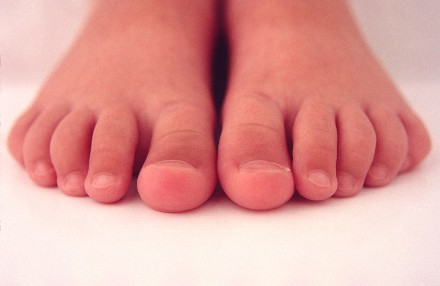
- FEET -
Our feet are the intricate structures of fifty-two small bones each bound by four layers of muscle. The mechanism is a miracle combination of strength and flexibility, designed to support the weight of the whole body, maintain its balance, propel it in motion and to act as shock absorbers. To do their job efficiently the feet must be alive, supple and springy, otherwise their weakness will transmit up through the legs and into the hips and the rest of the body, throwing the whole structure out of alignment. Through the practice of yoga the feet gradually begin to come alive; the toes regain the independence of movement that they were born with, the arches lift, the ankles strengthen. To be stable and solid on our feet is to feel secure and confident at a very fundamental and profound level, giving us the base from which to walk tall through life. To achieve (a deep backbend) is impossible unless you have learned to establish a powerful connection between your feet and the floor.
Why, then, do most of us neglect them? Anyone who has suffered so much as an ingrowing toenail knows how we take our feet for granted most of the time, and how incapacitated we are when they cause us problems. Given their elemental importance, you would think that a large, wide, muscle-bound foot would be the ultimate aesthetic, and yet the foot has been the subject of fetishism and distortion; the idealised foot is small, delicate and soft, not a functioning clod-hopper. The most famously extreme example of this comes from China, where it was the custom to bind women’s feet from early childhood so that they remained tiny and became squashed-up to the point of deformity, thereby incapacitating the women. Throughout history small, soft feet have been the erotic ideal, representing class, a life of leisure, and beauty. ‘I don’t love you coz your feet’s too big,’ goes the jazz song. Until recently in the Western world – where most people can afford shoes – women particularly have stuffed their feet into shoes that are too small, squashed their toes into sharp points and thrown the balance of their whole weight onto towering heels with tiny stiletto bases, forcing them to walk with their bottoms stuck out and their hips swaying. Not only does this put intolerable strain on their lower backs and knees, but clearly restricts freedom of movement both practically and symbolically. Anthropologists may be excused for equating these dictates of Western fashion with the indignities once inflicted on women in China.
But there are many places in the world still, especially in cultures where it is normal to walk barefoot, as in India, in which beautiful feet are portrayed as strong, sinuous and flexible. This is particularly true of representations in the Buddha, as if real enlightenment were only possible with lovely wide, grounded feet.
(From Kathy Phillips' wonderful book, The Spirit of Yoga.)
We spend a great deal of time and effort wishing our bodies were thinner, or more flexible, or stronger, or taller or shorter, anything other than what they are. This just alienates body and mind, and since the goal of yoga is union of body, mind and soul, becoming comfortable in and with your body is a vital first step towards unity. Maybe start with your feet. Our feet are our foundations; our first point of contact with the earth, and just as with a house, if the foundations are shaky or poorly cared for, the rest of the structure will be weak. Start to watch how you stand, where you carry your weight, and make subtle changes that will take you closer to balance.
You can do this in the queue at the supermarket, while brushing your teeth, in fact any time you are standing.
In your yoga practice, focus on the fine muscular adjustments in your foot as you stand in Tadasana (Mountain Pose) or balance on one leg in Vrksasana (Tree Pose). Wear comfortable shoes, walk barefoot, have a pedicure or reflexology. Celebrate your feet, your foundations, and enjoy how they support you all day, and particularly in yoga class!
The Yoga of Shopping
What Anita Roddick, founder of the Body Shop, realised decades ago, is that what we buy affects the people who made that item, the people who grew the raw ingredients, the environment, and our own well-being. It’s a long chain of people, creatures (sometimes) and plants, and every cent we spend can be used to the greater good. So we can take our yoga practice off the mat and into the supermarket or clothing store.
It’s almost a form of economic voting. The more people choose to shop responsibly, the more big companies will feel it in their bottom line, and this creates a powerful force for change. This can already be seen in SA, where the organic food industry has grown from a mere R5 million per annum three years ago, to around R155 million currently, according to Leonard Mead, head of industry body Organics SA. To paraphrase Renee Bonorchis in the Business Day, August 30, 2005, this growth has so alarmed large (chemical) fertilizer company, Omnia, that in their 2005 annual report, Chairman Neville Crosse made an attack on organic food, quoting an outdated British Foods Standards Agency study, run by Sir John Krebs, a man thought by many to be a proponent of genetically modified food. Crosse ignored all more recent studies, which have shown that organic food is in fact richer in most essential nutrients, and of course lacking in chemical residues from the products his company makes.
The first step towards yogic spending is becoming aware of how we spend our money. Do we know where our food was grown, how it was grown or if people were paid a fair wage to grow it? Do we know where our clothes were made, once again, were they made with fair labour practices?
Start small, with one focus, so that it’s not too overwhelming, trying to change all your shopping habits at once. Maybe you don’t want to harm animals, or perhaps you are worried about the environmental effect of all those chemical herbicides, pesticides and fertilizers, not to mention genetic modification. Perhaps the plight of people in Asian sweatshops worries you. Every bit you do will help, far more than you think.
Woolworths have been at the forefront of making organic produce available to the general public, and in the last few months costs have dropped considerably – organic fruit or veggies now cost much the same as their chemically and genetically altered cousins. And they offer a range of organic dairy, eggs and meat, which are infinitely preferable. Animals on modern farms are usually treated as commodities – they lead miserable, overcrowded, drugged lives, all for the sake of maximum productivity, so if we choose to consume animal products, organic gives us the guarantee that the animals are not medicated unless they are sick, are allowed to range freely, and lead generally more pleasant lives. If we believe in ayurvedic philosophy, we will understand that the life an animal leads influences the quality of prana or life-force we get from eating dairy, eggs etc.
You may choose to take your responsible food shopping even further, and stop buying meat, chicken and fish, eliminating the deaths of animals altogether from your shopping cart and shopping karma!
Buying South African products is another great way to positively influence our economy. The Proudly South African campaign has made it much easier for us to identify ‘home-made’ products, by the nifty little flag on their tags, and most items say where they were made – locally made products not only help our immediate community, they also remove the environmental impact and costs of long-distance transportation. Our textile industry has come under considerable pressure recently, with the removal of import controls and a flood of cheap imports from China. Human rights groups have reported great difficulty in accurately monitoring the conditions in Chinese factories, so buying South African is the better route. For every South African clothing designer whose business takes off, there are new jobs for pattern makers, seamstresses, shop assistants and textile mill workers.
On this note, you may decide you want to make sure you are buying fair-trade products. This means that the people who grew or made the product were paid a fair market price, sufficient to live on. It is quite shocking how often this is not the case. Two favourite comfort foods, coffee and chocolate, are among the worst offenders. According to John Robbins, author and activist, the bulk of the world’s cocoa is grown in Ivory Coast, and the big confectionery companies pay the farmers such a low rate that the farms often resort to slave labour to make ends meet. Yes, slave labour, in this day and age. The only sure way to make sure your chocolate or cocoa is human-friendly is to buy organic, since there are no organic farms in Ivory Coast. As for coffee, growers in South America are paid less per kilo than they were 20 years ago, resulting in a vicious cycle of increasing impoverishment. All Seattle Coffee Company coffee is now fairly traded, in the wake of the US coffee scandal several years ago, and they offer several very tasty organic coffees too.
There are many other ways to influence the world around you with your “cash vote” – you could buy environmentally friendly cleaning products, energy saving light bulbs, or you could buy all this years Christmas presents from the numerous street vendors at a traffic light near you!
Just as a butterfly flapping its wings can cause a storm on another continent, one change, made by one of us, makes ripples of changes, and before we know it, MacDonald's will be serving food as wholesome and ethical as that at your local health store!
Subscribe to:
Posts (Atom)